
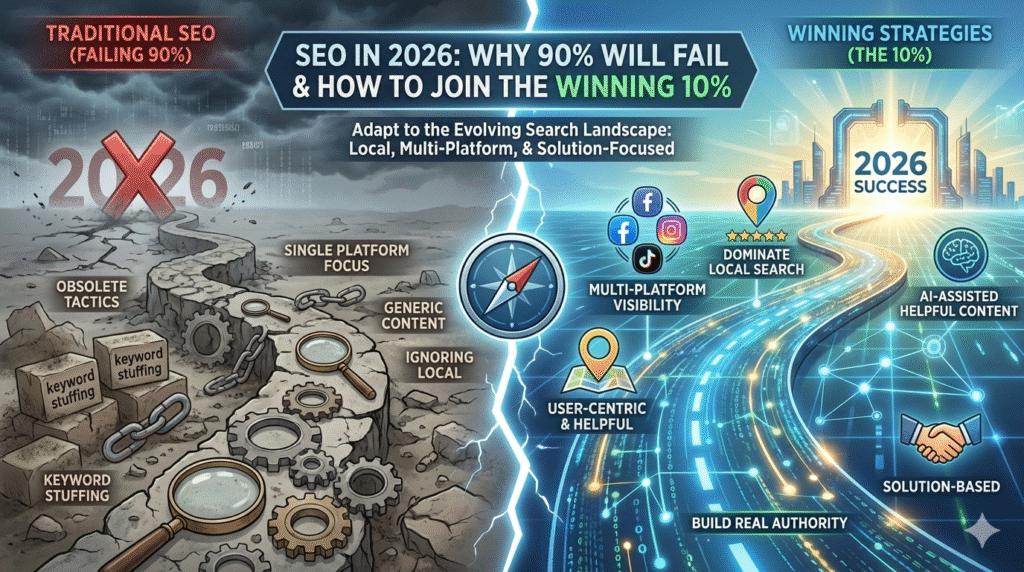
I’ve been in the SEO industry for years, and what I’m seeing right now genuinely concerns me. The game is changing faster than most businesses realize, and if you’re still doing SEO the “traditional” way, you’re setting yourself up for failure.
After analyzing hundreds of ranking patterns and testing strategies across multiple industries, I need to share what’s actually working right now—and what’s about to stop working completely.
The Search Landscape Has Fundamentally Changed
Here’s something that might surprise you: SEO is no longer just about ranking on Google. I know that sounds contradictory, but stay with me.
Last week, I was searching for a local contractor. The top result wasn’t a website—it was a Facebook group post where real people were recommending businesses. Google is now indexing social media conversations and prioritizing them in search results.
This isn’t a fluke. It’s a pattern I’m seeing repeatedly across different searches and industries.
What this means for you: Your website alone isn’t enough anymore. You need visibility across multiple platforms where your customers are actually searching—Instagram, TikTok, Facebook, and yes, still Google.
But here’s the good news: you don’t need to create unique content for each platform. Film one video, write one post, and repurpose it everywhere. The key is consistent presence, not constant creation.
Local SEO: The Massive Opportunity Everyone’s Missing
While everyone’s fighting over national keywords, there’s a gold mine hiding in plain sight: local search.
I work with a dentist in Hamilton, Ontario. Two years ago, they were struggling to get patients despite spending thousands on SEO. We shifted their entire strategy to local SEO, and within six months, they were booked solid.
Here’s why local SEO works so well right now:
The competition is manageable. Instead of competing with thousands of businesses globally, you’re competing with maybe 20-30 in your area. As a local business owner, this is your biggest advantage.
The intent is higher. When someone searches “dentist near me,” they’re not browsing—they’re ready to book. These searches convert at significantly higher rates than general searches.
It’s easier to dominate. With the right approach, you can outrank every competitor in your area within months, not years.
How to Actually Win at Local SEO
Based on what’s working in 2024 and 2025, here’s what you need to do:
First, optimize your Google Business Profile religiously. This isn’t optional. Post weekly updates, respond to every review (yes, even the bad ones), and keep your information current. I’ve seen businesses double their visibility just by maintaining an active profile.
Second, get reviews consistently. Not just once—consistently. After every completed job or service, send your customer a direct link to leave a review. Make it effortless. Reviews are one of the strongest ranking factors Google uses for local search.
Third, create content about your local area. Don’t just write generic blog posts. Write about local events, use local landmarks in your content, and target specific neighborhoods. Instead of “best Italian restaurant,” target “best Italian restaurant near Beamsville waterfront.”
These three strategies alone will put you ahead of 90% of your local competitors who aren’t doing any of this.
The AI Content Reality (What Google Actually Cares About)
Let’s address the elephant in the room: AI-generated content.
There’s been massive fear-mongering about this. People claiming Google will penalize AI content or that you must write everything by hand. After testing this extensively, I can tell you definitively: that’s not how it works.
Google has stated repeatedly—they don’t care if content is human-written or AI-written. They care if it’s helpful.
I use AI in my content creation process. I’ll record a video sharing my experience, get the transcript, and use ChatGPT to help structure it into a blog post. But—and this is crucial—I add my real experiences, specific examples, and actual results I’ve achieved.
AI content that solves real problems ranks. AI content that’s generic garbage doesn’t. It’s that simple.
The key is using AI to accelerate your process, not replace your expertise. Your experience and unique insights are what make content valuable. AI just helps you communicate it faster.
Solution-Based SEO: The Only Strategy That Matters Now
Here’s what changed: Google’s algorithm has gotten incredibly sophisticated at understanding intent. It’s no longer about keyword density or exact match phrases. It’s about solving the actual problem behind the search.
Let me show you what I mean with a real example from my own content:
Old approach: “SEO Tips for Small Businesses”
New approach: “How a Local Bakery Got 50 New Customers Per Month Using These 3 SEO Strategies”
See the difference? One is keyword-focused. The other promises a specific solution with proof.
My Framework for Creating Content That Ranks
After creating hundreds of pieces of content, here’s the process that works:
Step 1: Identify the real problem. Don’t just look at keywords. What’s the actual pain point? For a plumber, it’s not “SEO tips”—it’s “I’m not getting enough service calls.”
Step 2: Provide a complete solution. Walk through every step. Don’t hold back valuable information hoping they’ll hire you. Give them everything. Paradoxically, the more you give away, the more people trust you.
Step 3: Show proof it works. Include specific results, screenshots, case studies. I show actual analytics from my clients (with permission) because numbers don’t lie.
Step 4: Make it immediately actionable. Don’t just say “optimize your website.” Show them exactly which tools to use, what settings to change, and what results to expect.
This approach works because you’re genuinely helping people, not trying to manipulate search engines.
Your 2026 SEO Action Plan
Based on everything I’m seeing in the data and real-world results, here’s what you need to do right now:
Go multiplatform immediately. Set up and optimize your Google Business Profile, create profiles on Instagram and Facebook, and start posting weekly. Same content, multiple platforms.
Double down on local. Target your specific city or neighborhood, build citations on local directories, and make getting reviews a standard part of your customer process.
Focus on quality over quantity. Stop churning out mediocre blog posts. One exceptional, deeply helpful article beats ten shallow ones every time.
Build real authority. Share your actual process, show real results, and be transparent. People can smell fake expertise a mile away.
The Bottom Line
SEO isn’t dying—it’s evolving to reward businesses that genuinely help people. The algorithm crackdown on manipulation tactics means the shortcuts don’t work anymore. But that’s actually good news if you’re willing to create real value.
The businesses crushing it in 2026 will be the ones who stopped chasing rankings and started solving problems. They’ll be visible across multiple platforms, deeply embedded in their local communities, and known for genuinely helpful content.
The opportunity is massive, but only if you adapt now. Start with one thing this week: audit your Google Business Profile and make sure it’s completely optimized. Then build from there.
The 10% who win in 2026 will be the ones who started preparing today. Which side of that divide do you want to be on?